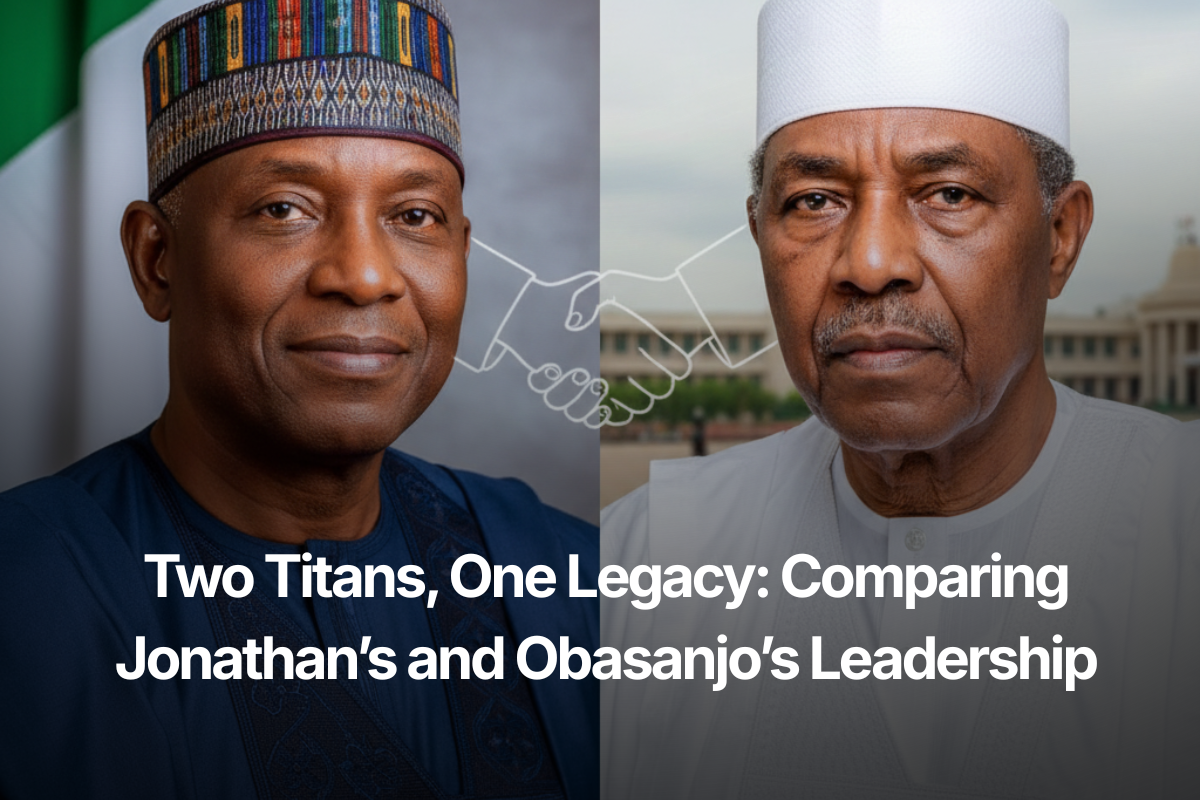
When you discuss modern Nigerian politics, two names dominate the conversation: Olusegun Obasanjo and Goodluck Jonathan. They are linked not just by the office they held, but by a complex relationship of mentor and protégé that turned into a fierce, public rivalry.
But when people ask the question, “Was Jonathan a great leader, especially compared to Obasanjo?” you can’t give a simple yes or no. You have to look past the political noise and examine their records. Both men navigated massive challenges—from economic instability to insurgencies—but they brought vastly different styles to the job.
This isn’t about choosing a side. It’s about providing an honest, human-centric analysis of their tenures. We’ll break down their key successes, their undeniable failures, and how their contrasting leadership styles defined an era.
The Obasanjo Era (1999–2007): The Architect of Modern Reforms
Obasanjo took office as Nigeria transitioned from military rule to democracy. His leadership was defined by bold, sometimes controversial, structural changes designed to pull the nation back from the brink of collapse.
A. Economic Surgery: Debt Relief and Privatization
Obasanjo’s team secured one of Nigeria’s greatest financial achievements: the $18 billion debt relief deal with the Paris Club. This single action freed up massive state resources. He was aggressive in privatizing key, underperforming state assets, like the telecommunications sector.
-
Impact: The GSM revolution transformed Nigeria, creating millions of jobs and opening up the economy. Nigeria’s foreign reserves soared dramatically under his watch.
-
The Criticism: His privatization drive was often criticized for a lack of transparency and for allegedly concentrating wealth in the hands of a few connected individuals.
B. The Anti-Corruption Fight
He established the Economic and Financial Crimes Commission (EFCC) and the Independent Corrupt Practices and other related Offences Commission (ICPC). These agencies, particularly the EFCC, went after high-profile figures, signaling a new era of accountability.
His style was authoritative and centralized. Obasanjo was known for his decisive, hands-on approach and his willingness to confront internal and external opposition head-on. He was a force of nature who believed in tough love for the nation.
The Jonathan Era (2010–2015): The Advocate of Transformation
Goodluck Jonathan’s rise was one of Nigeria’s most compelling political stories—a minority figure who ascended from Vice President to President. His administration focused on structural transformation and decentralizing economic opportunities.
A. Economic Growth and Power Sector Reform
Nigeria, under Jonathan’s watch, became Africa’s largest economy in 2014, driven by a rebasing of the GDP. His administration launched the ambitious Roadmap for Power Sector Reform, finally privatizing key generating and distribution companies to address Nigeria’s perennial power crisis. He created institutions like the Nigerian Mortgage Refinance Company (NMRC) and modernized the railway system.
B. Expanding Democratic Space and Concession
Jonathan is globally lauded for his commitment to democracy. His administration oversaw some of the most credible elections in Nigerian history up to that point. Crucially, his peaceful concession of power in 2015, the first time an incumbent president lost and conceded in Nigeria, cemented his place as a democrat who prioritized the nation over personal ambition.
-
The Criticism: His government struggled immensely with the rising Boko Haram insurgency, particularly after the Chibok abductions. Critics often pointed to a perceived lack of urgency and widespread, high-level corruption that undermined his transformational agenda.
His style was generally seen as less confrontational and more consensus-driven than Obasanjo’s, which many Nigerians appreciated as a contrast to the old military style, but which others perceived as weakness in the face of daunting national problems.
The Leadership Verdict: It’s Not a Single Score
The core of the “Jonathan is great leader Obasanjo” argument is often a stand-in for a debate on leadership style vs. impact.
| Feature | Obasanjo’s Tenure (1999–2007) | Jonathan’s Tenure (2010–2015) |
| Defining Action | Securing Debt Relief & Anti-Corruption Drive | Peaceful Concession & Power Sector Reform |
| Leadership Style | Highly Authoritative, Centralized, Decisive | Consensus-Driven, Academic, Decentralized |
| Economic Performance | Structural Reforms, High Reserves Growth | GDP Rebasing, Strong Non-Oil Sector Growth |
| Biggest Challenge | Stabilizing a nascent democracy | Boko Haram Insurgency & Corruption |
So, was Jonathan a great leader? His supporters point to economic modernization, the railway revival, and the democratic maturity of his concession. Was Obasanjo a great leader? His legacy rests on debt cancellation, privatization, and institutionalizing the anti-corruption fight.
You can respect Obasanjo’s iron will and his monumental achievements in debt relief while also celebrating Jonathan’s foundational democratic concession and economic reforms. Both men left indelible marks. True greatness in leadership isn’t about being universally loved; it’s about making high-impact decisions that change the nation’s trajectory. You decide which trajectory matters most.