The quote, “I swear if ISIS bomb any city in Russia, Islamist die half hour,” is a dramatic, internet-age summary of a political stance. While President Vladimir Putin may never have uttered those exact words, the sentiment behind them—an absolute, unyielding commitment to ruthless retribution against terrorists—is fundamental to his public image and his two-decade-long political career.
For anyone seeking to understand Russia’s approach to terrorism and its military actions, particularly in the Middle East and the Caucasus, you have to understand the uncompromising language that defines Putin’s war on terror.
This is not just rhetoric; it is a policy rooted in history, specifically the brutal terror attacks that defined the beginning of the 21st century in Russia.
The Real Quote That Defined Putin’s Career
The true, verified quote that set the tone for Vladimir Putin’s entire tenure is far more famous and equally shocking. It came in September 1999 following a series of deadly apartment bombings in Russian cities, which were blamed on Chechen militants.
When asked what would be done with the terrorists, Putin, then the relatively unknown Prime Minister, delivered the phrase that rocketed him to national prominence:
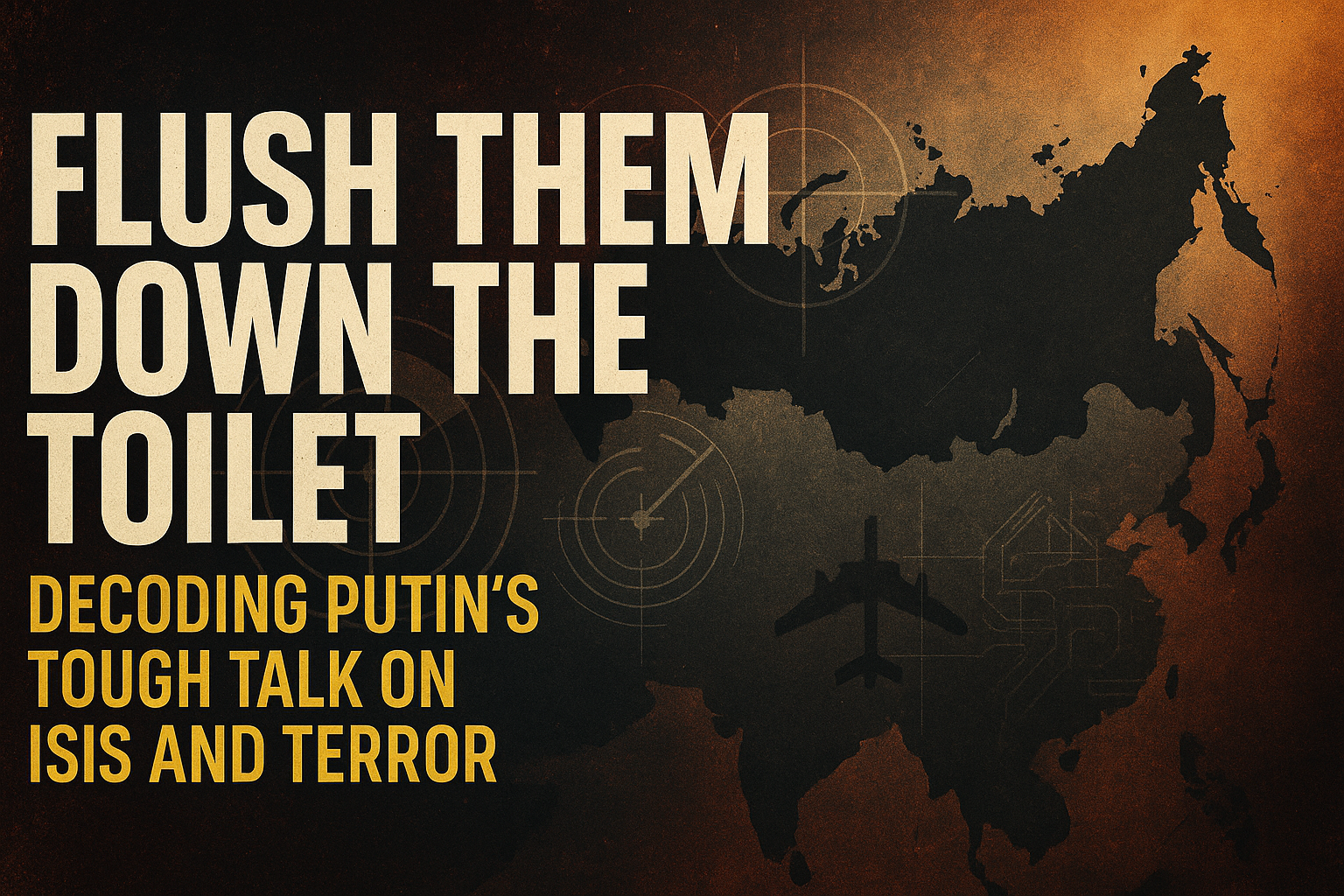
“We will pursue the terrorists everywhere. If we find them in the toilet, we’ll wipe them out in the outhouse. End of story.”
This raw, street-level language, known in Russian as “mochit v sortire” (literally “to wet/wipe in the outhouse”), signaled a radical break from the cautious, post-Soviet political style. It conveyed four key messages that form the foundation of Russia’s counter-terrorism strategy:
-
Zero-Tolerance: No negotiations, no quarter given.
-
Total Commitment: The hunt would be relentless, no matter where the terrorists hid.
-
Ruthless Force: The response would be disproportionate and brutal.
-
National Strength: The government would protect its people at any cost, projecting an image of necessary toughness.
This single statement provided the moral and political justification for the Second Chechen War and established Putin’s public image as the definitive strongman.
Russia’s History with Islamist Extremism and ISIS
The exaggerated “half hour” quote reflects the high-stakes reality of Russia’s genuine and persistent threat from Islamist militancy, which long predates the rise of ISIS (Islamic State).
A. The Caucasian Crucible
The root of the threat stems from the North Caucasus, particularly the separatist conflicts in Chechnya. Over time, the secular Chechen independence movement became heavily influenced and often taken over by radical Islamist elements. This led to horrific acts of terrorism on Russian soil, including:
-
The 2002 Moscow theater hostage crisis (Dubrovka).
-
The 2004 Beslan school siege, where over 330 people, including 186 children, were killed.
These traumas are key to understanding the national mandate for the ruthless approach to counter-terrorism. The public traded civil liberties for the promise of security delivered by a strong state.
B. The ISIS Threat and the Syria Intervention
Russia views ISIS and its affiliates, such as ISIS-K (Khorasan), not as a remote threat but as a direct domestic danger. A significant number of foreign fighters joining ISIS in Syria and Iraq originated from Russia and the former Soviet states in Central Asia.
The core motivation for Russia’s 2015 military intervention in Syria was presented, in part, as a strategy to fight terrorists there so they wouldn’t have to fight them at home. In his public addresses, Putin made it clear that defeating the group on foreign soil was a matter of national security, repeatedly stating the danger of having these seasoned fighters return to Russia.
The Doctrine of Pre-emptive and Immediate Retaliation
The popular quote’s emphasis on speed (“die half hour”) is a dramatic encapsulation of Russia’s doctrine of pre-emptive action.
In a famous speech on the need for decisive action, Putin once referred to the streets of his hometown, Leningrad (St. Petersburg), where he learned a key lesson:
“Fifty years ago, the streets of Leningrad taught me one thing: if a fight is inevitable, you have to hit first.”
This philosophy translates directly into Russia’s military and security posture against terrorism:
-
Intelligence Priority: The security apparatus (FSB, the successor to the KGB) is tasked with neutralizing threats immediately and often pre-emptively, using aggressive methods that often draw international criticism.
-
Targeted Elimination: When a terrorist attack occurs, the stated goal is not arrest and trial, but the swift and complete elimination of the operational cell responsible, followed by the leadership that ordered the attack. This approach reinforces the image of immediate, overwhelming state power.
The hyperbolic “half hour” quote, therefore, resonates because it perfectly captures the public promise: any attack on the Russian people will be met with a response so fast and so final that the terrorist act will be immediately regretted by its perpetrators. It is the language of a state that values absolute security above all else.