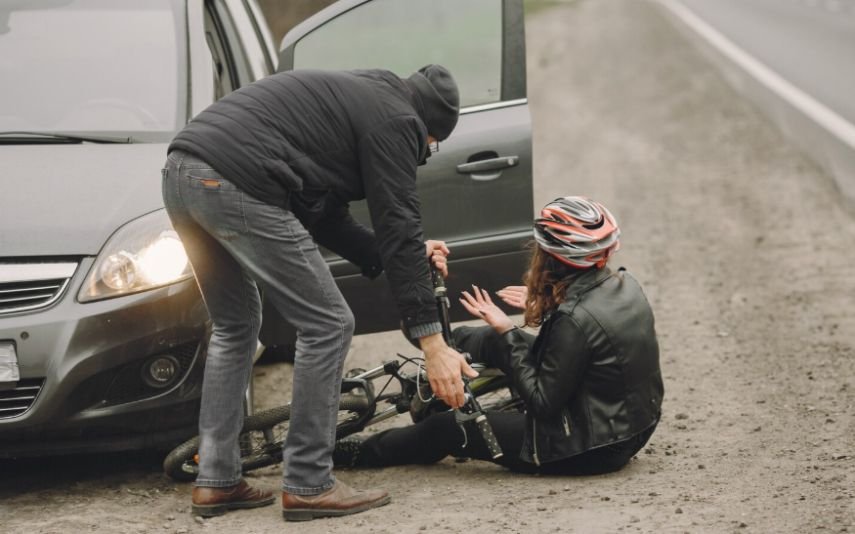
You don’t feel it when it happens. That’s the first thing that surprises people.
You go down, you slide, you come to a stop, and the first thing your brain does is inventory: bike, helmet, traffic, is anything broken. Adrenaline handles the rest. You might even stand up and wave off help. It’s only when you peel back a sleeve or look down at your hip in decent light that the picture arrives, and by then the nerve endings have started reporting in.
What follows is a two-week process that most riders get partly wrong, usually because of one piece of advice they absorbed as a kid. Here’s how the recovery actually goes.
Minute One: You Don’t Feel It Yet
The reason road rash hurts so much later is the same reason it looks so bad early. This isn’t really a scrape.
Cleveland Clinic classifies road rash as a friction burn, and that’s the useful way to think about it. The friction between skin and asphalt generates heat, and the injury behaves like a thermal burn does. Nerve endings sit in the upper dermis. Grind off the epidermis above them and you’ve exposed a wide field of raw nerve with nothing over it. That’s why a shallow abrasion the size of your palm can hurt more than a deep cut.
It also explains why the pain climbs for the first hour instead of fading. Adrenaline drops. The exposed surface dries. Everything starts talking at once.
Hour One: The Cleaning Nobody Warns You About
This is the worst part, and it’s also the single most important thing you’ll do in the entire recovery.
Every piece of grit left in that wound gets sealed under new tissue as you heal. When that happens it doesn’t come out later. It becomes what clinicians call a traumatic tattoo, a permanent grey-blue stippling in the skin, and removing it afterward means a dermatology procedure rather than a washcloth.
So the wound has to come genuinely clean. Lukewarm running water, mild soap, a few minutes of patient work, and gentle removal of debris. Mayo Clinic’s guidance is explicit about not scrubbing aggressively, which is a real temptation when you can see dirt and want it gone. Skip the hydrogen peroxide and the alcohol too. Both damage the healing tissue you’re trying to protect, and neither cleans better than plain water.
If gravel won’t come out, if you can see fat or muscle, if the wound is on your hands, face, or over a joint, that’s a clinic visit rather than a bathroom job. Same if you can’t remember your last tetanus shot.
The Scab Advice You Grew Up With Is Wrong
Here’s the part that matters most, and it’s where most riders lose a week.
Somebody told all of us to let it breathe. Let a scab form. Toughen up. That advice is decades out of date, and following it will slow your healing and worsen your scarring.
Wounds heal faster in a moist environment. Keeping the wound bed moist lets new skin cells migrate across the surface to close it, which is the actual mechanism of healing. Let it dry into a hard scab and those cells have to burrow underneath and around the crust instead, which takes longer. The scab also cracks every time you move, reopening the wound and restarting the clock.
The practical version is simple. Thin layer of petroleum jelly or antibiotic ointment, non-stick dressing over the top, changed daily. UW Health’s road rash guidance describes washing the wound gently once a day, removing loose dead tissue and softened scab as you go. Research on moist wound healing supports the same approach, with better healing times and better scar appearance than dry healing.
The hardest part is psychological. A properly managed abrasion looks worse than a scabbed one for the first week. It stays pink, weepy, and open-looking, and every instinct tells you it’s not healing. It is. It just doesn’t have a crust on it to reassure you.
And whatever you do, don’t pick. Picking extends healing time significantly and is the single largest self-inflicted contributor to a scar you’ll be looking at in ten years.
Days Three to Five: The Ugly Middle
Around day three the wound starts weeping clear or slightly yellow fluid. This alarms people. It shouldn’t. Clear serous drainage is normal and is part of how the wound keeps itself moist.
This is also the stretch where the dressing changes get old. The area is stiff in the morning. Sleep is awkward because you can only lie one way. Clothing catches on the dressing. Nothing appears to be improving.
Then somewhere around day five the surface starts looking less raw and more organized, and the daily change stops being a production.
| Stage | Roughly when | What you’ll see |
| Raw and painful | Day 0 to 2 | Bright red, exposed, worst pain of the whole process |
| Weeping | Day 3 to 5 | Clear or pale yellow drainage, looks alarming, is normal |
| Closing | Day 6 to 10 | Surface organizing, new pink tissue at the edges moving inward |
| New skin | Day 10 to 14 | Dull pink, no longer moist, stops stinging on contact |
| Remodeling | Month 1 to 24 | Color fades slowly, tissue strength builds, scar matures |
Chart suggestion for the editor: a simple two-bar comparison of healing time under moist versus dry management, sourced to the moist wound healing literature.
The Line Between Healing and Infected
Normal healing looks messy. Infection looks different, and knowing which is which saves you a lot of unnecessary worry and occasionally a lot of trouble.
Watch for red streaking spreading outward from the wound, thick or foul-smelling discharge rather than clear fluid, a fever above 100.4°F, warmth and swelling that’s expanding rather than settling, or pain that increases after the 48-hour mark instead of easing. Any of those means see someone rather than wait it out.
There’s also a simple time rule worth holding onto. Most road rash heals within about two weeks with decent care. If yours hasn’t, that’s information. It usually means the wound is deeper than it looked, and deep abrasions occasionally need clinical management up to and including grafting. Two weeks and still open is a reason to get it looked at, not a reason to try harder at home.
Week Two: The Pink Skin Test
You’ll know you’re through it by feel more than by sight.
The wound is healed when the surface looks dull pink or red, is no longer moist or weepy, and doesn’t sting when you touch it. That’s the threshold. At that point you stop the ointment and dressings and switch to keeping the new skin moisturized, because fresh skin dries and cracks easily and the tightness and itching are genuinely unpleasant.
The itch, incidentally, is the most underrated part of this whole thing. It arrives right when the pain leaves and it is maddening. Moisturizer helps more than willpower.
Month Three and Beyond: The Part Riders Forget
Here’s what gets skipped in every recovery conversation. The wound closing is not the end of the process.
Scar tissue keeps remodeling for somewhere between twelve and twenty-four months, and during that window it has almost no functional pigment protection of its own. Expose fresh scar tissue to sun without cover and you get post-inflammatory hyperpigmentation, meaning the area darkens permanently. Once that pigment settles into the tissue, it is extremely difficult to reverse.
The financial effects of a crash can also outlast the visible injury, especially when a damaged vehicle has to be replaced. Before applying for a new auto loan, learning how your credit score affects car financing can help you understand likely interest rates, monthly payments, and the true cost of borrowing during recovery.
The recommendation across dermatology sources is consistent: shield new scars from UV for at least twelve months, longer for darker skin tones or scars that had complications. Broad-spectrum SPF 30 to 50, reapplied, or simply cover the area.
For a cyclist or a motorcyclist this is an awkward truth, because the healing period lands squarely in riding season and the affected skin is usually forearm, shoulder, or thigh. Sleeves are the easier answer than remembering sunscreen every two hours.
Emerging Therapies: The Role of Peptides in Post-Surgery Recovery

While traditional protocols like rest, nutrition, and physical therapy form the foundation of postoperative healing, modern regenerative medicine increasingly looks at specific amino acid chains to accelerate tissue repair.
- Accelerated Tissue Regeneration: Specific research on peptides for healing are frequently discussed in sports medicine and rehabilitation for their potential to support angiogenesis and collagen production.
- Targeted Inflammation Control: By modulating inflammatory pathways, these compounds may help reduce excessive swelling around surgical sites, helping patients regain mobility faster.
- Consulting Your Medical Team: Because peptide therapies require strict medical oversight, compounding pharmacy sourcing, and proper dosing, patients should always discuss these options directly with their surgeon or an integrated health specialist.
Getting Back On
The tissue timeline is the easy part to write down. The other half of the recovery doesn’t show up in any wound care guide.
Most people who go down hard find the first ride back is mentally harder than the dressing changes were. Corners feel different. You brake earlier. That fades, and it fades faster if you get back on sooner rather than building it up in your head for a month.
For some riders, however, a serious crash changes more than their confidence. A damaged vehicle may need to be sold, transferred, or handled by relatives when the owner can no longer manage the process. In those situations, deceased estate car sales services can help families deal with valuation, documentation, removal, and sale arrangements without adding further pressure during an already difficult period.
Take the wound seriously, clean it properly once, keep it covered and moist, leave the scab alone, and give the new skin a year of shade. Do that and in two years you’ll have a faint pale patch that you have to point out to people.
Do the opposite and you’ll have a permanent map of one bad afternoon.